CONFIRMED
Arduino has released App Lab 0.11, and the headline features are “production grade” release bundles and phone sensor streaming beyond the camera. The Arduino Team announced the update on the Arduino Blog on 22 October 2026, and Arduino’s software page now lists 0.11.0 as the current version for the UNO Q and VENTUNO Q.
What we know
Arduino confirmed on its blog that App Lab 0.11 can export production grade “Apps Releases.” You can package a project for deployment without leaving the tool. Arduino says the release also deepens integration with its Works with Arduino program.
Arduino describes an app release as a frozen, immutable package with locked dependencies. The goal is consistent behavior across compatible devices. Sketches ship pre-compiled, which Arduino says can reduce startup times. Remote dependencies, such as AI models, are downloaded at install time rather than bundled.
Arduino draws a clear line between this and the existing export feature, which it describes as a way to share a project. That earlier feature arrived in the App Lab release Arduino announced on 4 February 2026, alongside one-click .zip import/export, an integrated flasher for outdated board images, a “Work without WiFi” step and syntax highlighting.
The deployment workflow, per the Arduino Blog, has three steps: package the app into a ready-to-run file, install it on another board, then run it on compatible third-party hardware in the Works with Arduino program.
On the sensor side, Arduino says the Mobile Companion App now streams more than the camera. Microphone and IMU data reach App Lab through a new remote sensor peripheral, at high frequency over WebSocket, with password protection and encryption options. Data arrives as JSON with user-definable keys. Arduino adds that compatible external devices can also stream data to the board over the same WebSocket interface.
This builds on phone camera streaming to the UNO Q, which Arduino announced on 6 March 2026. At the time, Arduino said that feature used a local network connection rather than Arduino Cloud servers.
The Arduino Blog also confirms a new Pose Estimation Brick that runs locally on the VENTUNO Q. It tracks a 17-point body skeleton at up to 10 frames per second, draws a live overlay on the video stream, and supports custom poses.
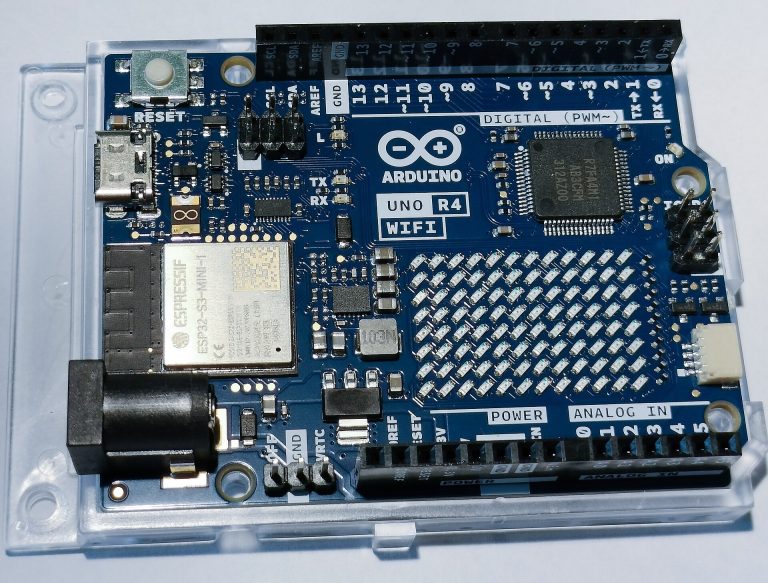
Arduino’s software page describes App Lab as supporting C++ sketches and Python, released as open source under GPL 3.0. For context, Hackster.io describes the UNO Q and the more powerful VENTUNO Q as “dual-brain” boards that pair a Qualcomm Dragonwing application processor with an STMicroelectronics STM32 microcontroller. Hackster.io also notes the UNO Q was announced alongside Qualcomm’s acquisition of Arduino. We have no sourced specs or prices for either board in this story.
What we don’t know yet
Arduino has not put a number on the startup time savings from pre-compiled sketches. “High frequency” sensor streaming also comes without a published sample rate or latency figure.
The Arduino Blog does not name specific third-party boards that can run these release bundles, so the compatible hardware list for Works with Arduino is still unclear from what we have.
The Pose Estimation Brick is only described as running on the VENTUNO Q. Arduino has not said whether it runs on the UNO Q.
We did not retrieve Arduino’s GitHub release page for 0.11, so a full changelog beyond the blog post is not covered here. Also, “production grade” is Arduino’s own label. We found no independent testing of 0.11 beyond Hackster.io’s coverage.
What it means
For UNO Q builders, the split between “export to share” and “release to deploy” is the practical change. A frozen package with locked dependencies means the app you tested is the app that runs on the next board, without a library update shifting underneath it. Since AI models download at install time, plan for a network connection during setup even if the device runs offline afterward.
The phone sensor feature turns a handset into a free IMU and microphone module. For prototyping gesture control or audio triggers, that skips wiring a breakout board. JSON with your own keys should be easy to parse on the Python side of App Lab.
If you follow older tutorials, check them against 0.11.0.
Follow every development in one place on our board release tracker.